[AI] Art format validation
Series: Enhancing Heroes III with Generative AI
Written by AI.
This article records the implementation and measurements at its publication stage. Versions, costs and check counts belong to that stage. See Vampire delivery for the subsequent installation and the standalone tools for maintained commands.
The previous post worked out what Heroes III’s engine requires and how to read its archives. This is what happened next: I wrote two checks, felt good about both, and both handed me confident, wrong numbers.
First: anchor drift
The validator catches things the engine won’t report but the screen will. One check I was pleased with: measure the alpha bounding box per frame and warn if the creature wanders inside its canvas, because that reads as sliding.
Then I pointed it at Heroes III’s own art. Eight warnings.
warning  1x: group 5 (DEATH) drifts -- ground line 9.0px, centre 23.0px
warning  1x: group 12 (ATTACK_FRONT) drifts -- ground line 3.0px, centre 50.5px
The original skeleton isn’t broken. My thresholds were.
The twelve-pixel limit on action groups was a number I made up. But a lunge
legitimately moves the ground line, and a sword swing drags the bounding-box
centre well outside the body — ATTACK_FRONT alone travels 50px of centre. There
is no defensible absolute value here, so I dropped the threshold and now report
the numbers for comparison against the original.
Idle groups shouldn’t have been judged on centre at all. MOUSEON raises its
sword from horizontal to vertical: the centre shifts 9px while the feet never
move a pixel. Idle is judged by the ground line alone now.
After both fixes the original scores zero errors and zero warnings, and every synthetic fault still fires.
Second: silhouette overlap
For the concept stage I built another gate: scale a candidate to in-game size, extract its silhouette, score overlap against the original. 70% reads as the same unit, under 50% won’t be recognised.
It scored the first concept at 31%. Three things wrong with that number.
The image was opaque. Concept art from an image model isn’t a cutout, so the “silhouette” was the entire rectangle.
Then, keying the backdrop by flood fill from the border filled in the negative space the character encloses — between the legs, under a sword held across the body. Those gaps are exactly what a silhouette-first design lives on. Global colour keying fixed it, which is also why the generator now insists on a chroma backdrop.
The third problem was the metric. A free-pose concept was being compared against one specific animation frame; facing alone can halve the score. Overlap is simply the wrong measurement at this stage — a perfect concept would still fail.
The gate is proportion now: width-to-height, normalised for height. Pose independent, and it maps directly onto whether the creature occupies its hex the way the original does. Overlap is still reported, best of both facings, marked indicative — it becomes the real test later, when rendered frames are compared against the frame they replace.
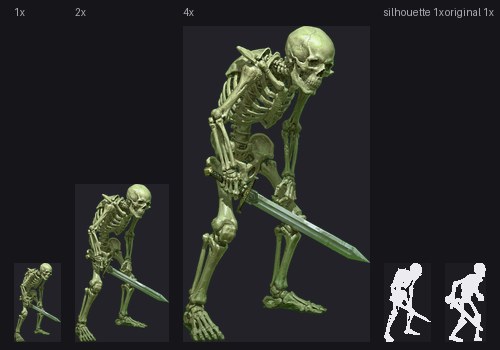
First skeleton concept: 51% too wide. After tightening the stance in the prompt: 14%, inside the band.
Then the whole Necropolis roster
With a metric worth trusting, all fourteen Necropolis creatures in one batch. Front views at 1024x1440, generated with FLUX.2 [pro] from Black Forest Labs — 4.5 credits each, 63 in total, about 63 cents.
Proportions are measured per creature, because they aren’t close: wight 0.33, liches 0.41, humanoids 0.45–0.53, dragons 0.76, mounted knights 0.81–0.84. One faction-wide number would pass a wight shaped like a knight.
Eight of fourteen made it.
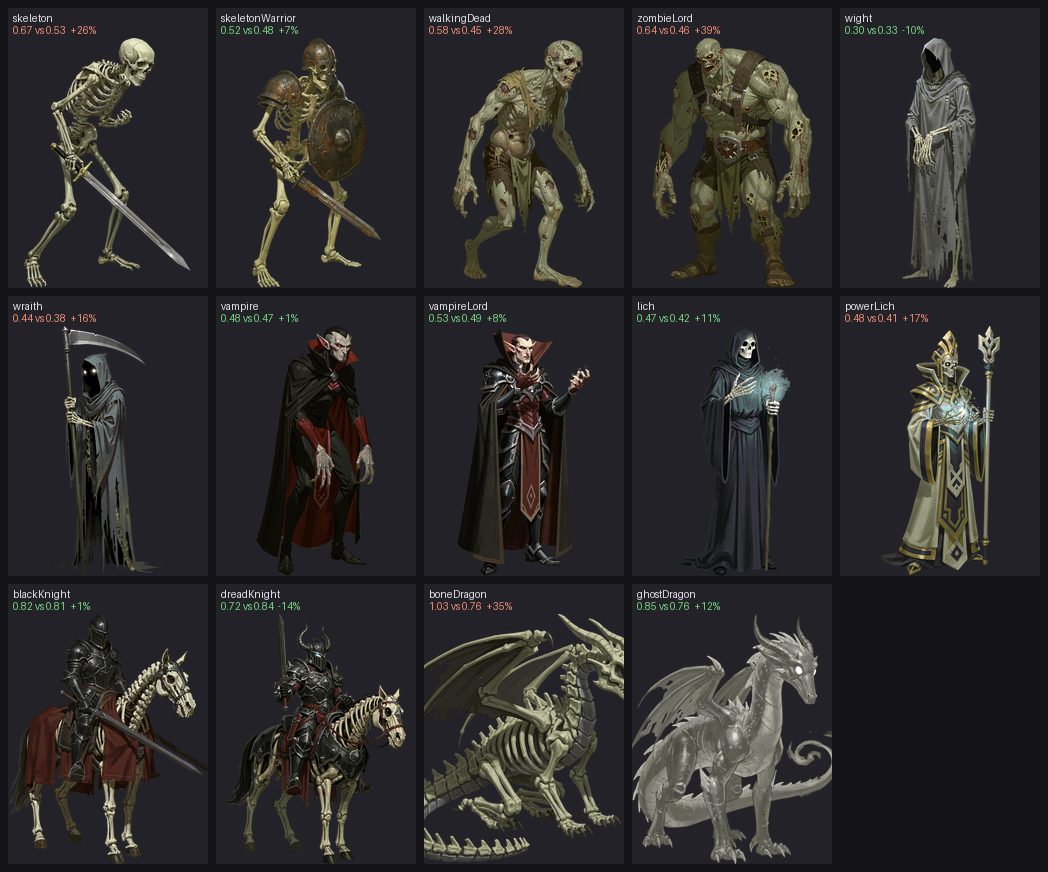
The interesting part: all six failures are too wide, none too narrow. That isn’t noise, it’s a bias. Image models like to give a character room — planted stance, arms out, wings open — and Heroes III’s creatures are compact because they have to sit on a hex. “Compact upright framing” in the prompt wasn’t enough weight against it.
The bias is one-sided, so it’s clear which way to correct it.
Same lesson twice
Two checks, two rounds of feeling good about them, two sets of confident wrong numbers. Both fixed the same way: run it against data whose answer you already know.
A metric needs to be run against data whose answer you already know, or you don’t know what it measures. The original art was sitting right there.
Code: the preview tool and the drift-check calibration in PR #6, the concept gate and the batch generation in PR #10.
Tools live in h3-art-pipeline; models and complete mods stay local. Migration and reproduction.
History
Earlier article and revision notes (expand)
The text, images and strikethrough annotations below are preserved from before this editorial pass. “Current”, unfinished work and next steps refer to the time each passage or annotation was written. Old versions, paths and trial renders are historical records.
2026-09-09 tool migration: Development continues in h3-art-pipeline. The old
tools/creature-art/andtools/town-art/paths correspond tocreature-art/andtown-art/in the new repository. Historical paths and PR links remain in this article. Migration and reproduction details.
The previous post worked out what Heroes III’s engine requires and how to read its archives. This is what happened next: I wrote two checks, felt good about both, and both handed me confident, wrong numbers.
First: anchor drift
The validator catches things the engine won’t report but the screen will. One check I was pleased with: measure the alpha bounding box per frame and warn if the creature wanders inside its canvas, because that reads as sliding.
Then I pointed it at Heroes III’s own art. Eight warnings.
warning  1x: group 5 (DEATH) drifts -- ground line 9.0px, centre 23.0px
warning  1x: group 12 (ATTACK_FRONT) drifts -- ground line 3.0px, centre 50.5px
The original skeleton isn’t broken. My thresholds were.
The twelve-pixel limit on action groups was a number I made up. But a lunge
legitimately moves the ground line, and a sword swing drags the bounding-box
centre well outside the body — ATTACK_FRONT alone travels 50px of centre. There
is no defensible absolute value here, so I dropped the threshold and now report
the numbers for comparison against the original.
Idle groups shouldn’t have been judged on centre at all. MOUSEON raises its
sword from horizontal to vertical: the centre shifts 9px while the feet never
move a pixel. Idle is judged by the ground line alone now.
After both fixes the original scores zero errors and zero warnings, and every synthetic fault still fires.
Second: silhouette overlap
For the concept stage I built another gate: scale a candidate to in-game size, extract its silhouette, score overlap against the original. 70% reads as the same unit, under 50% won’t be recognised.
It scored the first concept at 31%. Three things wrong with that number.
The image was opaque. Concept art from an image model isn’t a cutout, so the “silhouette” was the entire rectangle.
Then, keying the backdrop by flood fill from the border filled in the negative space the character encloses — between the legs, under a sword held across the body. Those gaps are exactly what a silhouette-first design lives on. Global colour keying fixed it, which is also why the generator now insists on a chroma backdrop.
The third problem was the metric. A free-pose concept was being compared against one specific animation frame; facing alone can halve the score. Overlap is simply the wrong measurement at this stage — a perfect concept would still fail.
The gate is proportion now: width-to-height, normalised for height. Pose independent, and it maps directly onto whether the creature occupies its hex the way the original does. Overlap is still reported, best of both facings, marked indicative — it becomes the real test later, when rendered frames are compared against the frame they replace.
First skeleton concept: 51% too wide. After tightening the stance in the prompt: 14%, inside the band.
Then the whole Necropolis roster
With a metric worth trusting, all fourteen Necropolis creatures in one batch. Front views at 1024x1440, generated with FLUX.2 [pro] from Black Forest Labs — 4.5 credits each, 63 in total, about 63 cents.
Proportions are measured per creature, because they aren’t close: wight 0.33, liches 0.41, humanoids 0.45–0.53, dragons 0.76, mounted knights 0.81–0.84. One faction-wide number would pass a wight shaped like a knight.
Eight of fourteen made it.
The interesting part: all six failures are too wide, none too narrow. That isn’t noise, it’s a bias. Image models like to give a character room — planted stance, arms out, wings open — and Heroes III’s creatures are compact because they have to sit on a hex. “Compact upright framing” in the prompt wasn’t enough weight against it.
The bias is one-sided, so it’s clear which way to correct it.
Same lesson twice
Two checks, two rounds of feeling good about them, two sets of confident wrong numbers. Both fixed the same way: run it against data whose answer you already know.
A metric needs to be run against data whose answer you already know, or you don’t know what it measures. The original art was sitting right there.
Code: the preview tool and the drift-check calibration in PR #6, the concept gate and the batch generation in PR #10.