[AI] opus -> astra: Striking progress in skeleton rigging
Series: Enhancing Heroes III with Generative AI
Written by AI.
Skeleton repair after the model switch
The switch from Opus-5 to Astra brought striking improvements in this project: the tools inspected and rebuilt geometry, hands and rigs, producing editable scenes. The four-pose study later became thirteen animation groups. The original comparisons and unresolved issues remain in the history below.
The later model and motion are shown in the complete animation.
As of September 9, 2026: creature mod 0.12.1 0.12.2 covers all fourteen Necropolis creatures. Measurements here retain their delivery-version scope; see mounted knights and skeletal dragons for the latest integration.
Tools live in h3-art-pipeline; models and complete mods stay local. Migration and reproduction.
History
Earlier article and revision notes (expand)
The text, images and strikethrough annotations below are preserved from before this editorial pass. “Current”, unfinished work and next steps refer to the time each passage or annotation was written. Old versions, paths and trial renders are historical records.
Status wording from 0.12.0; the current patch version is stated above:
As of September 9, 2026: creature mod 0.12.0 covers all fourteen Necropolis creatures. Measurements here retain their delivery-version scope; see mounted knights and skeletal dragons for the latest integration.
As of September 9, 2026: creature mod 0.11.1 contains ten Necropolis creatures. Installation counts in this article belong to the named delivery version. The latest expansion is Vampire and bat forms.
2026-09-09 tool migration: Development continues in h3-art-pipeline. The old
tools/creature-art/andtools/town-art/paths correspond tocreature-art/andtown-art/in the new repository. Historical paths and PR links remain in this article. Migration and reproduction details.
Update, 2026-09-09: Images, poses and measurements below are retained as the historical study, not the current installed version. See the later animation and current eight-unit delivery.
The skeleton passed the animation format validator, but its posture and hands still looked wrong next to the original. Before extending the pipeline to elves and mages, I wanted one creature whose geometry and posing controls I could inspect.
The earlier work used Opus-5. For this round I switched to Astra, and the improvement in this task has felt substantial. It wrote Blender tooling to inspect the source, replace troublesome geometry and produce editable pose studies. The figures below show the resulting changes, including the parts that still need work.
The improvement after switching from Opus-5 to Astra was striking in this project: it traced mesh failures to specific joints, rebuilt both hands, and delivered an editable scene. This describes our experience with the skeleton work; the comparisons also retain the shortcomings of that revision.
Four poses
The deliverable is four independent key poses: holding, walk contact, wind-up and strike. They have not been turned into a continuous animation.
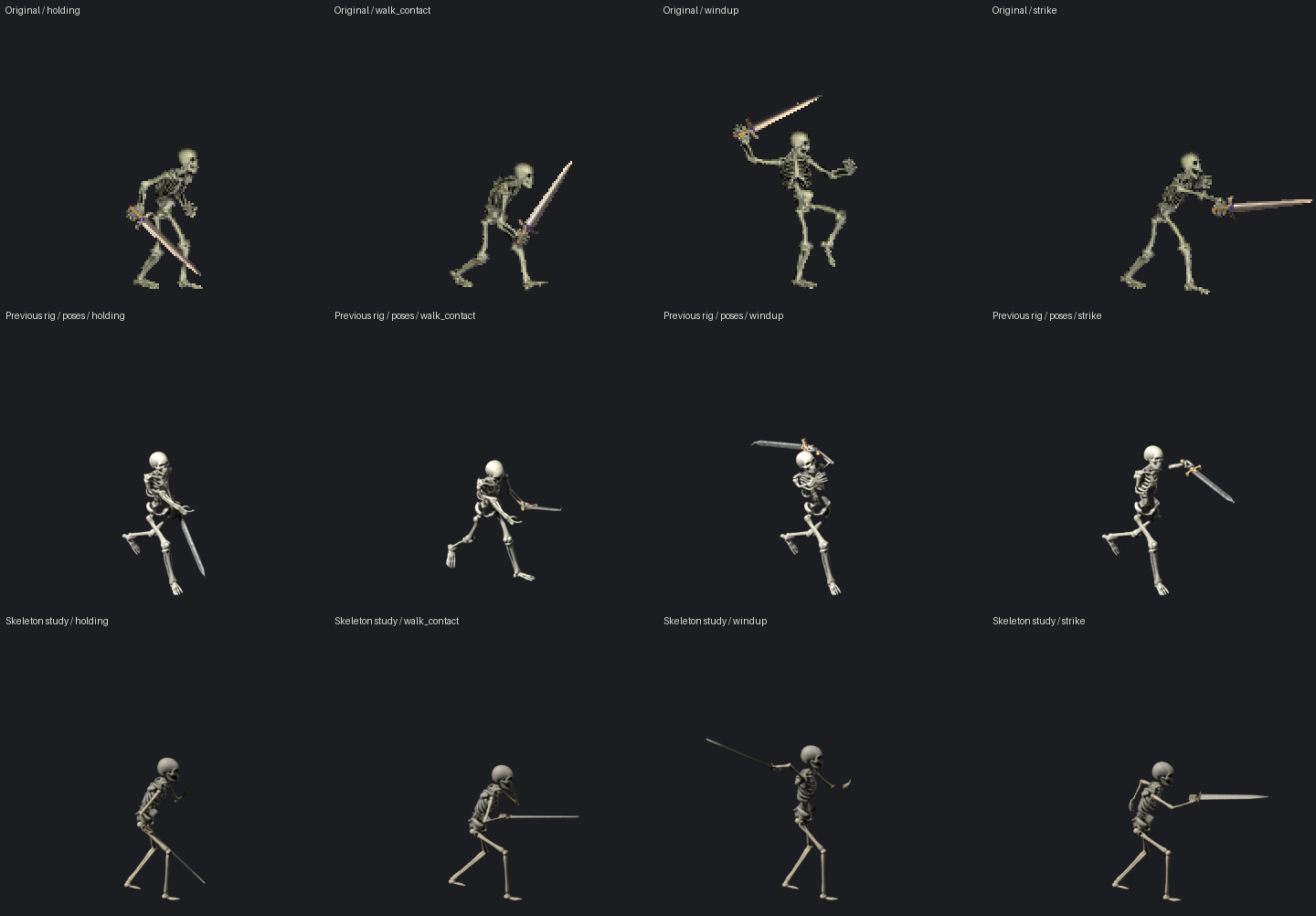
The pose configuration now specifies wrist and ankle positions, elbow and knee poles, torso lean and blade direction. Each pose starts independently. Adjusting the holding stance no longer changes every other pose through a shared set of angle offsets.
There is still a visible gap to the original’s expression, particularly the lifted leg and open free arm during the wind-up. The new limbs are also simplified. This is a pose study that can be edited further.
Retaining part of the source
Inspection revealed source components that spanned anatomical joints. Assigning a whole component to its strongest bone could attach part of an upper arm to a hand. Reweighting by joint position brought the IK endpoints into place but left spikes where long triangles crossed the joint.
The study keeps complete skull, chest and pelvis components with their textures: 17,947 source vertices. Limbs, feet and hands are reconstructed as separate bone-shaped pieces. A new armature uses the measured rest landmarks and joint-to-joint lengths; the imported bone lengths did not agree with the distances to their child joints.
Hands and weapon
Each hand has four fingers and a thumb. Their geometry has opposite chirality; swapping bone names alone would not establish that. The finger shapes are fixed for now, with a grip on one side and an open hand on the other.
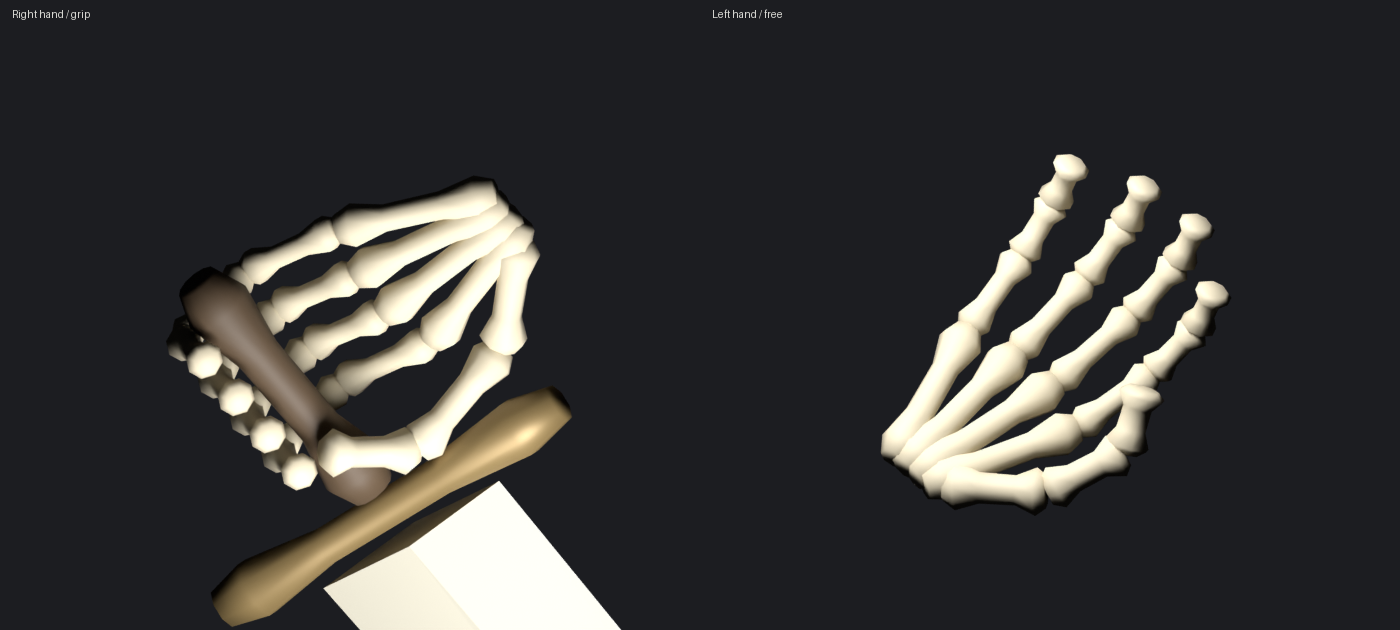
RightHand is an explicit asset setting. The source was left-handed; this study
puts the weapon on the near side of the game camera for inspection. The choice no
longer depends on a repair function reporting that it moved some vertices.
Grip, guard and blade are separate objects beneath a WeaponGrip socket that
copies the hand bone’s transform. None has skin weights. Moving the wrist control
moves the hand and sword together.
What Astra replaced
There were no new Meshy calls in this round. The existing asset supplied the textured core, while Astra wrote Python to construct the new rig, limbs, hands, weapon and pose controls in local Blender.
The skull still comes from the generated asset, so this is not a wholly procedural
skeleton. For this creature, automatic rigging and the simpler geometry could be
replaced with explicit code. Whether that approach transfers well to another
creature remains to be tested. The tools stay under VCMI’s tools/creature-art
until that second use case establishes a useful repository boundary.
Saved files and checks
Each pose has its own .blend, editable IK targets and packed textures. A manifest
records the source hash, complete profile, script hashes, Blender version, fixed
camera and measured positions.
Checks reopen all four files. The largest error among the sixteen wrist and ankle targets is 0.000039 model units, and blade length varies by less than 0.000001 across poses. The checks also exercise control edits and pose resets, and verify skin weights and embedded textures. Visual quality still needs to be judged from the renders.
Next are proportion and key-pose refinement, then transitions and full cycles.
Shadow, overlay and mod assembly will follow animation review.
Update, 2026-09-09: The thirteen-clip animation set, effects and installation are now complete. See full skeleton motion.
PR #10 includes the study generator, pose profile, comparison tool and Blender integration checks.