[AI] Zombie animation set
Series: Enhancing Heroes III with Generative AI
Written by AI.
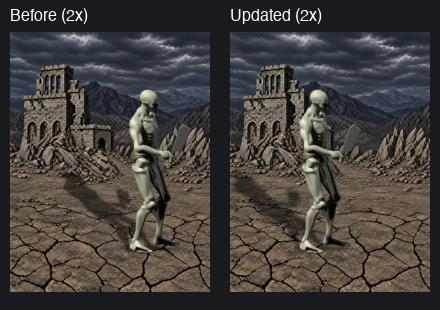
October 2 gait revision: local 0.12.3 updates these creatures’ movement and transitions; see the new frame comparisons and battle. Modeling, cost and delivery records below retain their historical scope; walking motion in older videos has been superseded.
As of September 9, 2026: creature mod 0.12.1 0.12.2 covers all fourteen Necropolis creatures. Measurements here retain their delivery-version scope; see mounted knights and skeletal dragons for the latest integration.
Walking Dead (CZOMBI) is installed with thirteen groups and 80 frames per scale. The CZOMLO upgrade is covered in the upgrade delivery.
Placement, shadows and first display
Bodies, shadows and hover outlines are supplied at 1×/2×. Shifting the skeleton by 25 logical pixels brought its panel center to x=49.5; the walking dead moved from x=75 to x=50. These changes also affect battle-canvas placement, while preserving canvases and frame counts.
Shadows use a fixed ground line, continuous alpha and mild spatial blur, with 1× reduced from the 2× projection. Maximum adjacent-frame alpha change during walking fell from 1.083 to 0.643 for the skeleton and from 0.489 to 0.357 for the walking dead. This pixel metric does not establish flicker-free motion; the six playback comparisons show its scope.
Effects are computed during packaging and loaded as saved PNGs. A preparation benchmark of the early two-creature package measured 203.8 seconds for generated effects and 0.51 seconds for saved effects. It excluded GPU upload and startup, with OS caches unflushed; this is not a startup speedup measurement. Raw results.
Registration, effects and installation passed resource checks without engine changes. Contact and pacing still need per-motion review. The body-only videos below are authoring previews, while the installed package includes shadows.
Motion authoring
The zombie is the second creature for the editable Blender workflow. It gives us a skin deformation case after the skeleton’s separate rigid bones. The initial holding, walking and front attack now extend to thirteen groups, with a playable comparison gallery.
Astra continues to write the local tools. The body mesh and textures come from the earlier Meshy asset; this pass made no new Meshy calls. The videos retain the body renders used for review; the installed package also includes the effects described below.
A missing cleaver
The old zombie profile described an unarmed character and reduced the amplitude
of skeleton attack keys. Looking at CZOMBI.DEF shows a short cleaver: the original
raises it overhead before chopping forward.
The replacement right hand has a palm, four curled fingers and a thumb. Its cleaver has a separate handle and blade attached through a RightHand socket, without skin weights. The textured left hand stays open. The grip material is simple and the fingers have fixed shapes for now.
Skin and joint lengths
The body retains 24,400 textured vertices and their original skin weights, with preserve-volume deformation. That keeps the skin continuous around the elbows and knees instead of reconstructing rigid limb pieces as we did for the skeleton.
The imported joint heads were plausible, but the longest bone extended 42.666 model units across a roughly 1.7-unit character. Rebuilding bone tails from the next joint heads reduced that length to 0.426664. An oversized display bone does not by itself prove that the old rotation animation stretched the skin; the problem here is using that length for an IK chain.
There are now wrist and ankle targets with elbow and knee poles. Each of the thirteen clips is a
packed, editable .blend file, accompanied by the source fingerprint, profile,
code snapshot and render settings.
An asymmetric walk
The stride is 0.38 model units, with each foot in stance for 68% of its cycle. Right and left foot lifts are 0.035 and 0.070 respectively. The return curve matches stance velocity at its endpoints, and the hips have a small vertical sway. Sliding is measured after adding the forward displacement implied by the stance targets; the video does not move the character across a battlefield.
CZOMBI uses 8 holding frames, 10 walking frames and 7 front-attack frames. Both output scales preserve those counts: these three groups contribute 25 body frames per scale to the full set. Playback durations are authored review timings; identical counts do not establish correct engine playback speed.
The walking contact sheet uses a fixed scale for each version, without fitting individual frames. The original’s body outline and motion amplitude remain references for the next visual pass.

Reactions and a backward fall
The hit reaction compresses the stance, recoils with both arms opening, then recovers. Defence raises the cleaver beside the head and bends the knees before returning to holding.
The original falls backward with its legs folding up. The new death follows that direction: recoil, bend the legs, fall and settle on the back. A keyed root moves the skin, rig and controls together. Height correction uses the evaluated mesh minimum. The cleaver remains attached; the final leg arrangement still differs from the original.
Turns, transitions and attack directions
Each turn has three native frames. The whole character rotates, and the review sequence follows engine order: TURN_L, a facing flip, then TURN_R. The clips share the intermediate pose.
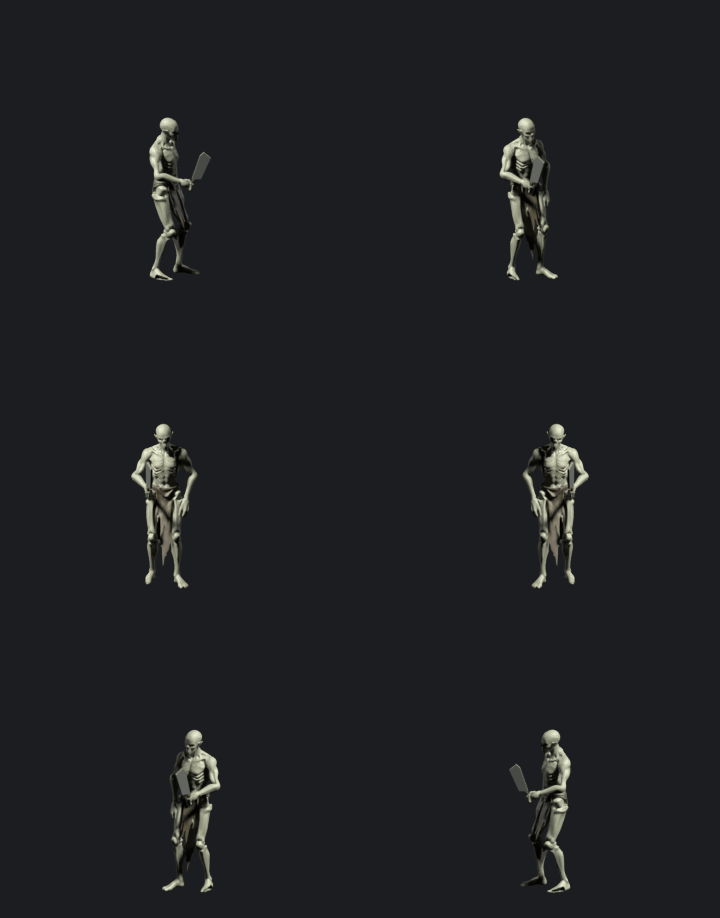
Movement start and end each have only one original frame. Editable clips retain the full transition; the native export samples its midpoint. Upward, frontal and downward attacks have separate wrist and torso targets. Strike tip heights are 1.857, 0.996 and 0.390 model units respectively; the low strike adds a crouch and forward fold.
Animation checks
The complete set has 80 body frames per scale, plus 338 dense review frames. Reopening all thirteen clips gives 667 integer/half-frame samples. Maximum IK error is 0.000094 model units; inferred stance drift is 0.000022. Checks cover loop closure, reaction recovery, start/end transitions, the turn bridge and distinct strike heights.
The lowest skin point remains 0.00147 units below the floor, within the 0.002 tolerance. The settled corpse’s highest skin point is 0.589 units. These checks cover rig consistency, not visual approval. The source still looks gaunt; its clothing and skin differ from the original, and the new grip needs a closer material match.
Tools live in h3-art-pipeline; models and complete mods stay local. Migration and reproduction.
History
Earlier article and revision notes (expand)
The text, images and strikethrough annotations below are preserved from before this editorial pass. “Current”, unfinished work and next steps refer to the time each passage or annotation was written. Old versions, paths and trial renders are historical records.
Status wording from 0.12.0; the current patch version is stated above:
As of September 9, 2026: creature mod 0.12.0 covers all fourteen Necropolis creatures. Measurements here retain their delivery-version scope; see mounted knights and skeletal dragons for the latest integration.
As of September 9, 2026: creature mod 0.11.1 contains ten Necropolis creatures. Installation counts in this article belong to the named delivery version. The latest expansion is Vampire and bat forms.
2026-09-09 tool migration: Development continues in h3-art-pipeline. The old
tools/creature-art/andtools/town-art/paths correspond tocreature-art/andtown-art/in the new repository. Historical paths and PR links remain in this article. Migration and reproduction details.
Next stage: Skeleton Warrior, Zombie, and the remaining Necropolis roster now have a separate progress post with all upgrade animation previews.
Showcase and shadow update (0.7.0): these showcase figures now use the accepted background. Walking dead moves from x=75 to x=50 inside its panel: all 160 body frames and companion shadows/outlines shift together. Skeleton keeps its existing registration. The offset also applies within the battle canvas; visible pixels, canvas dimensions and frame counts are preserved.
These are offline composites using the game’s crop, not screenshots. The user clarified that the background sharpness concern referred to the composite. No runtime low-resolution loading defect was established.
Previous shadows used each frame’s lowest pixel as a projection anchor, then thresholded alpha at 128. That anchor spans 4.5 logical pixels during skeleton movement, 6.5 during its front attack and 2.5 during walking-dead movement. The replacement uses fixed ground, continuous alpha and modest spatial blur, deriving 1x from the same 2x projection. There is no temporal averaging or animation delay. Maximum adjacent-frame alpha change during movement falls from 1.083 to 0.643 for skeleton and 0.489 to 0.357 for walking dead. This metric includes legitimate pose changes and responds to blur; it is not a perceptual flicker score. Attack changes do not all decrease. The six playable comparisons show that scope. All 324 shadows are prebaked, body/outline content is preserved, and final validation has zero errors or warnings. The installed package has a backup and takes effect after restart; engine source remains unchanged.
Game integration update: the complete export is installed alongside the
skeleton in the local necropolis-creature-animations mod. CZOMBI belongs to the
unupgraded walking dead; upgraded CZOMLO, map graphics and portraits are not
replaced. The package includes all 13 groups and 80 frames at each of 1x and 2x.
Walking-dead bodies are unchanged. An offline helper uses VCMI algorithms to
precompute simplified shadows and hover outlines from their alpha. The combined 324-image package passes original-DEF
validation with zero errors/warnings, and native mod loading succeeded. Full
battle placement, contact and timing still need native review. Existing videos
remain body-only. PR #10 documents installation.
Version 0.3.0 moves shadow and outline computation into packaging. An offline helper calls VCMI’s existing SDL3 functions and writes 324 shadow images plus 72 holding/hover outlines. Removing the generation flags lets the normal loader read those companion PNGs. Body frames, resolution and playback timing stay intact; no engine source changes are needed. All 396 saved effects match regenerated native pixels, and final asset validation has zero errors or warnings.
A fresh-process sweep of the entire 324-frame, two-scale package took 203.8 s with generated effects and 0.51 s with saved effects; another saved-effect run took 0.49 s. The game loads frames on demand, whereas this benchmark visits every frame. OS disk caches were not flushed, and GPU upload and game startup are outside the measurement. This establishes the cost removed from asset preparation, not an end-to-end startup multiplier. The raw results state that scope. Restart VCMI to use the new package; first-display behavior still needs an in-game check.
The zombie is the second creature for the editable Blender workflow. It gives us a skin deformation case after the skeleton’s separate rigid bones. The initial holding, walking and front attack now extend to thirteen groups, with a playable comparison gallery.
Astra continues to write the local tools. The body mesh and textures come from the earlier Meshy asset; this pass made no new Meshy calls. The videos retain the body renders used for review; the installation update above describes the game package.
A missing cleaver
The old zombie profile described an unarmed character and reduced the amplitude
of skeleton attack keys. Looking at CZOMBI.DEF shows a short cleaver: the original
raises it overhead before chopping forward.
The replacement right hand has a palm, four curled fingers and a thumb. Its cleaver has a separate handle and blade attached through a RightHand socket, without skin weights. The textured left hand stays open. The grip material is simple and the fingers have fixed shapes for now.
Skin and joint lengths
The body retains 24,400 textured vertices and their original skin weights, with preserve-volume deformation. That keeps the skin continuous around the elbows and knees instead of reconstructing rigid limb pieces as we did for the skeleton.
The imported joint heads were plausible, but the longest bone extended 42.666 model units across a roughly 1.7-unit character. Rebuilding bone tails from the next joint heads reduced that length to 0.426664. An oversized display bone does not by itself prove that the old rotation animation stretched the skin; the problem here is using that length for an IK chain.
There are now wrist and ankle targets with elbow and knee poles. Each of the thirteen clips is a
packed, editable .blend file, accompanied by the source fingerprint, profile,
code snapshot and render settings.
An asymmetric walk
The stride is 0.38 model units, with each foot in stance for 68% of its cycle. Right and left foot lifts are 0.035 and 0.070 respectively. The return curve matches stance velocity at its endpoints, and the hips have a small vertical sway. Sliding is measured after adding the forward displacement implied by the stance targets; the video does not move the character across a battlefield.
CZOMBI uses 8 holding frames, 10 walking frames and 7 front-attack frames. Both output scales preserve those counts: these three groups contribute 25 body frames per scale to the full set. Playback durations are authored review timings; identical counts do not establish correct engine playback speed.
The walking contact sheet uses a fixed scale for each version, without fitting individual frames. The original’s body outline and motion amplitude remain references for the next visual pass.
Reactions and a backward fall
The hit reaction compresses the stance, recoils with both arms opening, then recovers. Defence raises the cleaver beside the head and bends the knees before returning to holding.
The original falls backward with its legs folding up. The new death follows that direction: recoil, bend the legs, fall and settle on the back. A keyed root moves the skin, rig and controls together. Height correction uses the evaluated mesh minimum. The cleaver remains attached; the final leg arrangement still differs from the original.
Turns, transitions and attack directions
Each turn has three native frames. The whole character rotates, and the review sequence follows engine order: TURN_L, a facing flip, then TURN_R. The clips share the intermediate pose.
Movement start and end each have only one original frame. Editable clips retain the full transition; the native export samples its midpoint. Upward, frontal and downward attacks have separate wrist and torso targets. Strike tip heights are 1.857, 0.996 and 0.390 model units respectively; the low strike adds a crouch and forward fold.
Validation and remaining work
The complete set has 80 body frames per scale, plus 338 dense review frames. Reopening all thirteen clips gives 667 integer/half-frame samples. Maximum IK error is 0.000094 model units; inferred stance drift is 0.000022. Checks cover loop closure, reaction recovery, start/end transitions, the turn bridge and distinct strike heights.
The lowest skin point remains 0.00147 units below the floor, within the 0.002 tolerance. The settled corpse’s highest skin point is 0.589 units. These checks cover rig consistency, not visual approval. The source still looks gaunt; its clothing and skin differ from the original, and the new grip needs a closer material match.
Shadow and owner-overlay passes, mod assembly and battle playback/contact
checks remain. The full gallery currently contains body renders.
Update, 2026-09-09: Bodies, shadows and hover outlines are installed. The body-only gallery remains a historical authoring preview; installation does not complete battle timing/contact review.
PR #10 contains the rig, cleaver grip, thirteen clips, original-count exports and saved-animation checks.